When the same regions are observed at several times, add
time = and SDALGCP2 fits a separable
space–time model. This tutorial is self-contained.
The model
For region
at time
,
counts
with offset
:
with a separable
space–time covariance
i.e. ,
where
is the aggregated spatial correlation (range
)
and
a temporal Matérn correlation (range
).
SDALGCP2 never forms the
covariance — it uses the Kronecker identities
and
— so it scales to many regions and times. The temporal range
is estimated alongside
.
The data
One row per region and time, with the geometry repeated. Here four years on a 6×6 lattice:
library(SDALGCP2)
library(sf)

set.seed(7)
shp <- st_sf(geometry = st_make_grid(
  st_as_sfc(st_bbox(c(xmin = 0, ymin = 0, xmax = 18, ymax = 18))), n = c(6, 6)))
N <- nrow(shp); times <- 2019:2022; T <- length(times)

# simulate separable space-time counts (true beta=0.5)
pts <- sda_points(shp, delta = 1.4, method = 3)
Rs  <- precompute_corr(pts, 3)$R[, , 1]
Rt  <- SDALGCP2:::.temporal_corr(seq_len(T), 1.5, 0.5)
L   <- t(chol(0.4 * kronecker(Rt, Rs)))
x1  <- rnorm(N * T); pop <- round(runif(N * T, 1000, 5000))
y   <- rpois(N * T, pop * exp(-6 + 0.5 * x1 + as.numeric(L %*% rnorm(N * T))))

dat <- st_sf(
  data.frame(cases = y, x1 = x1, pop = pop, year = rep(times, each = N)),
  geometry = st_geometry(shp)[rep(seq_len(N), T)])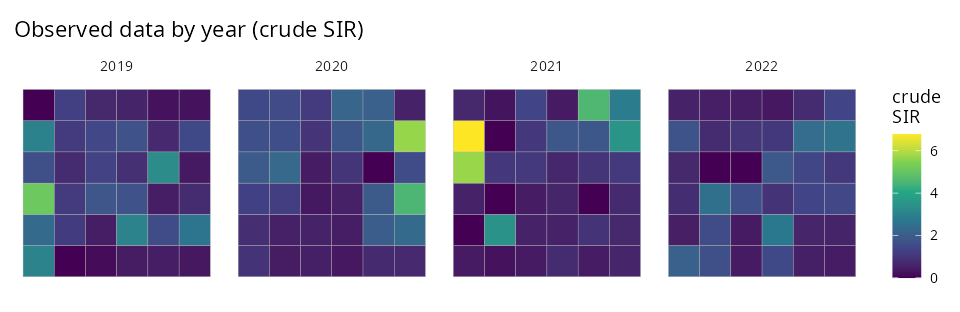
Fit
fit <- sdalgcp(cases ~ x1 + offset(log(pop)), data = dat, time = "year",
               control = sdalgcp_control(reanchor = 2))
summary(fit)
#> Coefficients:
#> Estimate Std.Err z value Pr(>|z|)
#> (Intercept) -6.167 0.107 -57.61 <2e-16 ***
#> x1 0.592 0.038 15.73 <2e-16 ***
#> sigma^2 0.491 0.205 2.39 0.017 *
#> nu 0.853 0.360 2.37 0.018 *
#>
#> Spatial scale phi: 2.02nu is the temporal range (correlation length in years);
phi the spatial range.
Predict and map — pick a year and a quantity
predict() returns a long sf — one row per
region and time, with columns
relative_risk, adjusted_rr and their standard
errors (the same column names as the spatial predictor, so you can
st_write() or map it directly). The plot()
method selects a time and a quantity
("relative_risk", "adjusted_rr",
"relative_risk_se", "adjusted_rr_se",
"exceedance"):
pr <- predict(fit)

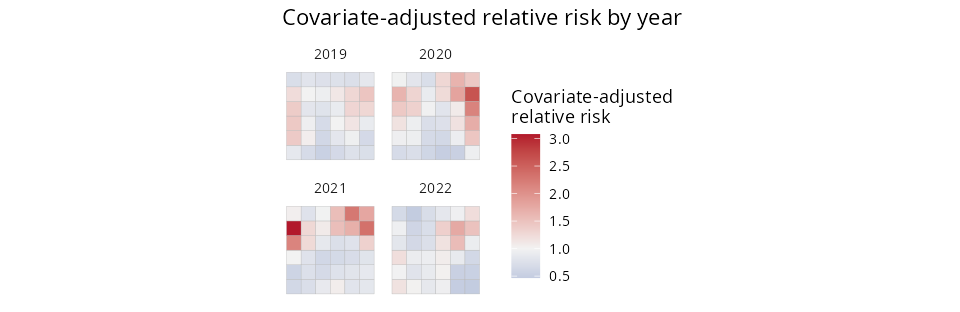
plot(pr, time = NULL, what = "adjusted_rr")          # facet all years
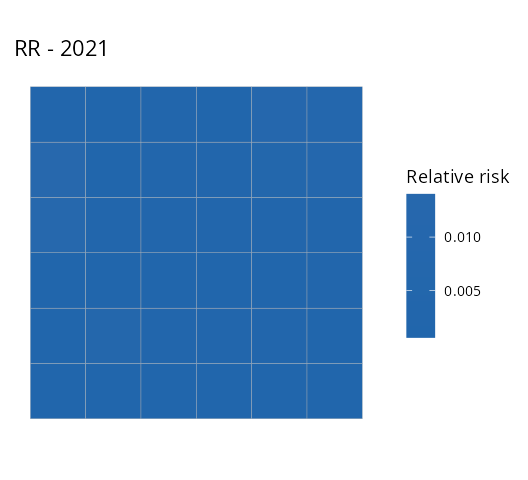
plot(pr, time = 2021, what = "relative_risk")        # relative risk, 2021 only
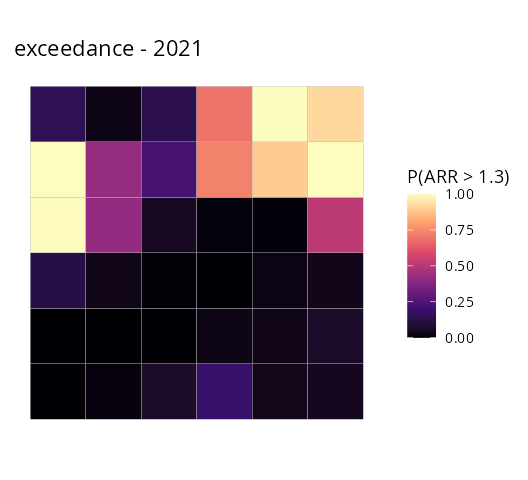
plot(pr, time = 2021, what = "exceedance", threshold = 1.3, which = "adjusted_rr")
Covariate-adjusted relative risk, all years:
| Relative risk, 2021 | P(adjusted RR > 1.3), 2021 |
|---|---|
 |
 |
You can equally call
plot(fit, time = 2021, what = "relative_risk") directly on
the fit, and pr (the returned sf) is a long
region × time table of every quantity for further analysis or
mapping.
Covariates and confounding
The space–time model supports the same covariate extensions as the
spatial one. The covariate surface is taken to be
time-invariant (a covariate that genuinely changes over
time can always go in as an ordinary data column); the
intensity- scale tilting is then computed once per region and reused
across the times, fitted by a Gauss–Newton loop around the space–time
likelihood.
Raster (intensity-scale) covariates — a spatially
continuous covariate supplied as a terra raster, aggregated
correctly under the log link (see the raster tutorial):
library(terra)
fit_r <- sdalgcp(cases ~ elevation + offset(log(pop)), data = dat, time = "year",
                 rasters = elevation_raster)
Misaligned covariates — a covariate observed on a different (time-invariant) support, e.g. pollution monitors, kriged to the candidate points with a Berkson correction (see misaligned covariates):
fit_m <- sdalgcp(cases ~ pm25 + offset(log(pop)), data = dat, time = "year",
                 covariates = list(pm25 = monitors_sf))
Spatial confounding — when a covariate is spatially smooth it can be collinear with the random effect; restricted spatial regression de-confounds the coefficient (see spatial confounding). It generalises to space–time by constraining the random effect orthogonal to the design over all region–times:
fit_c <- sdalgcp(cases ~ x1 + offset(log(pop)), data = dat, time = "year",
                 control = sdalgcp_control(confounding = "restricted"))
The restricted space–time fit reduces exactly to the spatial restricted fit when there is a single time, and forms the full covariance, so it is best suited to modest .